

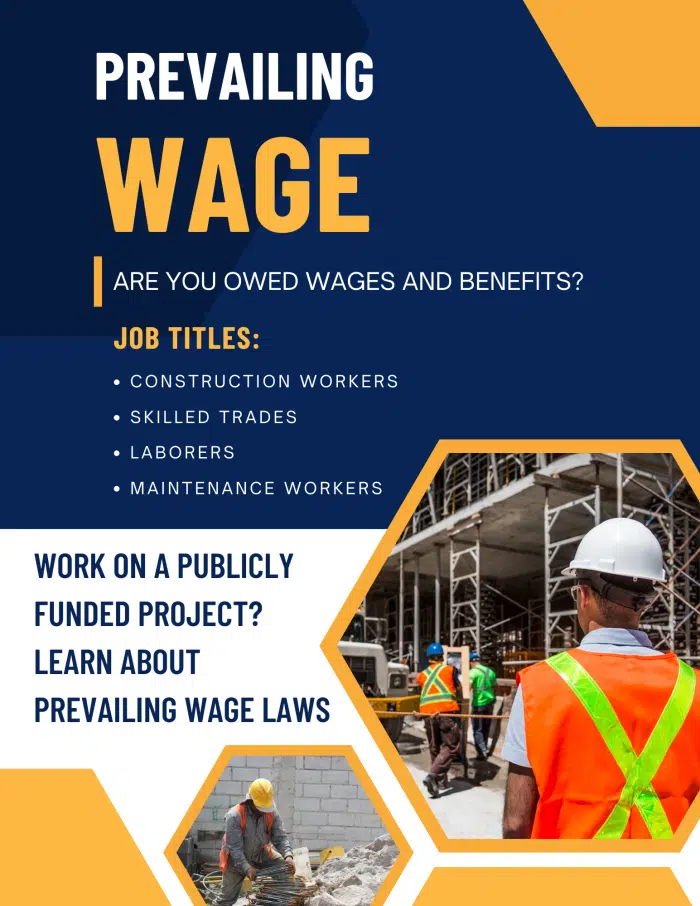
Are you working on a publicly funded project? You might be owed the prevailing wage, which can be over $100 an hour with benefits.
Prevailing wage laws protect millions of workers. A prevailing wage lawyer can help you recover unpaid wages and benefits.
What is Prevailing Wage?
Prevailing wages are the minimum rates workers must earn on government-funded public works and maintenance jobs. Contractors receive different rates based on the type of work and location.
The purpose of the prevailing wage is that the government wants to make sure that all workers on government-funded projects are paid fairly. Thus, workers for contractors and subcontractors on these projects must be paid a close approximation to union wages.
In addition to federal prevailing wage laws, cities and states also enforce rules to make sure workers receive fair compensation. The U.S. General Services Administration lists federal prevailing wage rates by trade at Wage Determinations.
How Does Prevailing Wage Work?
If you’re hired on a prevailing wage job, you must receive at least the prevailing hourly rate plus benefits.
For example, an electrician in New York might qualify for a prevailing rate of $60 per hour. They must also receive prevailing fringe benefits of $50 per hour. The electrician must either receive benefits worth $50 an hour or an additional $50 in hourly pay on top of their wages.
Laborers, construction workers, maintenance workers, and even some food service workers must receive the prevailing wage for their job title and location.
Prevailing Wage Jobs
Laborers, journeymen, and teamsters are often owed the prevailing rate for their work. Common job titles include: Carpenter, Electrician, Boilermaker, Bricklayer, Construction Engineer, Glazier, Laborer, Landscaper, Painter, Plumber, and Welder.
In some states, maintenance and building service workers also qualify. For example, in New York State, janitors, doormen, elevator operators, and porters working in qualifying buildings must receive the prevailing rate.
New York Prevailing Wage Laws
New York has some of the strongest prevailing wage laws in the country. Construction workers, building service employees, and food or temporary office services workers may qualify, depending on the location and contract.
NY Prevailing Wage
Contractors and subcontractors on public work contracts in New York State must receive the prevailing rate plus fringe benefits. The rate depends on the type of work, the county, and whether the worker receives benefits. For example, a boilermaker in Nassau County must receive $67.38 per hour in 2024, plus $26.85 or fringe benefits equivalent to that amount.
NYC Prevailing Wage
New York City also has its own prevailing wage laws covering building services, food services, and temporary office workers in addition to construction workers. For example, administrative assistants on temporary contracts at government agencies must receive at least $47.92 in wages and benefits. Porters at office buildings must earn $44.24.
After 2020, new construction projects with at least 120 units that receive over $1 million in city financial assistance must pay at least the prevailing rate for building service employees.
Prevailing Wage Violations
The most common prevailing wage violations include paying less than the prevailing rate or failing to pay fringe benefits. Contractors may also pay subcontractors less than the prevailing rate to pocket the cash and stiff laborers.
You can sue for back pay if you were owed the prevailing wage and did not receive it. Workers on federally funded public works projects must receive either the federal or state prevailing wage, whichever is higher.
Do You Qualify for Prevailing Wage?
In New York City, you may qualify if: you’re a construction worker on any NYC public work project, including streets, public schools, subway stations, and parks; you’re a building services worker at any city building, including residential buildings that qualify for city tax exemptions; you work on street excavations for a utility project; or you work in food services or temporary office services at a city agency.
The prevailing wage is a minimum, not a cap. You should also receive 1.5 times your prevailing rate for overtime hours.
If your employer violated these laws, you may be owed significant back pay. Reach out to employment lawyer Charles Joseph today to see if you have a prevailing wage case. Charles is the founder of Joseph & Kirschenbaum, a firm that has recovered more than $200 million for clients.